Salt air, humidity swings, and a salinity gradient that runs from the brackish upper rivers down to the higher-salinity water near Hampton Roads put more stress on a marine engine than most owners realize until something fails at the worst possible moment. A gasoline outboard idling out of a Deltaville dock and a Yanmar diesel auxiliary working upwind on the Rappahannock face different failure points, but both run on the same principle: engines that get attention on a schedule outlast engines that get attention only when they break.
Norton Yachts’ factory-certified service team works on Yanmar, Volvo Penta, Yamaha, and Mercury engines out of our boatyard in Deltaville, Virginia, on the Piankatank River at Milford Haven. This guide reflects what we actually tell owners who bring boats to us for service, not a generic checklist pulled from an owner’s manual.
If your engine needs attention now, our factory-certified technicians are available at (804) 776-9211, or you can schedule service directly at our service center. We work on sail auxiliaries, inboard diesels, and gasoline outboards from our full-service yard on the Bay.
Diesel Auxiliaries: Yanmar and Volvo Penta
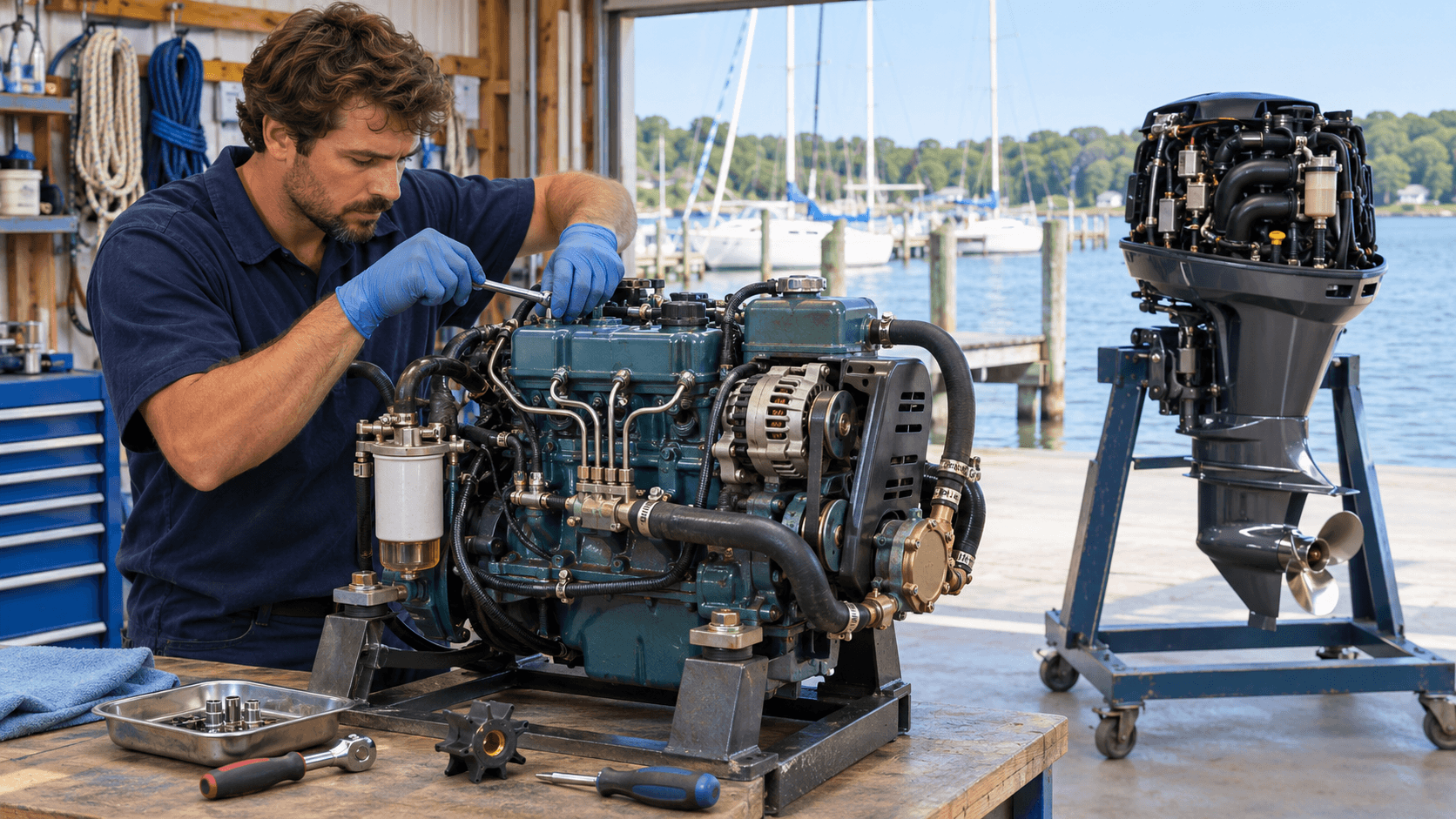
Most sailboats on the Bay, and many of the trawlers and downeast-style powerboats, run a small diesel such as a Yanmar 3YM30 or a Volvo Penta D2-series engine. These engines are built to run for thousands of hours, but Chesapeake conditions shorten the interval between services if the engine is not watched:
- Raw water pump impeller. Bay silt and summer grass intake clog these faster than clean offshore water does. We check the impeller at every haul-out and replace it on a fixed schedule rather than waiting for an overheat to tell us it failed.
- Fuel filters and water separators. Condensation inside a partially filled tank is a real problem on the Bay, where warm days and cool nights in spring and fall create moisture inside the tank. A clogged primary filter or water in the secondary is one of the most common calls our service team gets.
- Coolant and heat exchanger. Raw-water-cooled and freshwater-cooled systems both need the heat exchanger checked for scale buildup, which Bay salinity accelerates compared to freshwater lakes.
- Zinc anodes. Brackish water is more corrosive to unprotected metal than people expect. Anodes on the engine, shaft, and heat exchanger should be inspected at every haul-out, not just replaced when they are gone.
- Annual oil and filter change, and a compression check on engines with high hours, following the specific interval in that engine’s service manual. Intervals vary by model and use pattern, so we confirm the manufacturer’s schedule for each boat rather than applying one number across every Yanmar or Volvo in the yard.
Gasoline Outboards: Yamaha and Mercury
Pontoons, center consoles, and the outboard-powered Jeanneau NC series run on a different maintenance logic entirely:
- Fuel system care. Ethanol-blended pump gas is harder on an outboard’s fuel system than marine-specific fuel, and a boat that sits for weeks between trips is more exposed to phase separation. A fuel stabilizer in the tank between uses matters more on the Bay’s weekend-boater schedule than it does for a boat run daily.
- Water pump impeller, same logic as the diesel side: inspect at the start of the season and replace before it fails, not after.
- Lower unit gear oil, checked for the milky appearance that signals water intrusion through a worn seal, and changed on the manufacturer’s interval.
- Spark plugs and battery/charging system, inspected annually, with particular attention to corrosion at the battery terminals given the Bay’s humidity.
Diesel vs. Outboard: Why the Care Actually Differs
The honest answer is that a diesel auxiliary and a gasoline outboard fail in different ways and on different timelines. Diesels are more tolerant of long idle periods but less tolerant of fuel contamination and raw-water cooling neglect.
Outboards are more sensitive to fuel quality during long idle periods but more forgiving of the kind of intermittent use that defines most Bay boating. An owner who treats both the same way, usually by doing too little to either, is the person who ends up calling us mid-season instead of scheduling a pre-season checkup.
A Starting Framework for Service Intervals
Every engine has its own manufacturer-specified schedule, and the right move is always to confirm that schedule against the specific model aboard your boat rather than assume a generic interval. As a general framework for Bay use:
- Diesel inboards: oil and filter annually, impeller every one to two seasons depending on hours, fuel filters at least once a season and more often if water contamination is a recurring issue.
- Gasoline outboards: oil change per the manufacturer’s hour or time interval, whichever comes first, lower unit oil annually, water pump impeller inspected each spring.
Our service team can pull up the exact factory-specified interval for your engine model and build a maintenance schedule around it rather than a generic one. See our full breakdown of Yanmar diesel engine service for diesel-specific detail, and our marine electrical and plumbing services page for the rest of the systems that work alongside the engine.
For the bigger picture on how consistent maintenance affects what your boat is worth down the road, see our boat engine maintenance schedule guide.
Frequently Asked Questions
How often should a marine diesel engine be serviced?
It depends on the specific engine and how many hours it runs, but most Yanmar and Volvo Penta diesels need an oil and filter change at least annually, with impeller, fuel filter, and zinc checks at every haul-out. Check your engine’s manual for the exact factory interval.
What’s the biggest difference between caring for a diesel inboard and a gasoline outboard?
Diesels are more sensitive to fuel contamination and raw-water cooling neglect, while outboards are more sensitive to fuel quality during long idle periods and to corrosion. The maintenance calendar for each should be built around its own failure points, not a single generic schedule.
Can I do engine maintenance myself, or should I always use a certified technician?
Basic checks, such as oil level and visible corrosion, are reasonable for most owners to do themselves. Impeller replacement, fuel system work, and anything involving the cooling system are worth having a factory-certified technician handle, particularly on Yanmar and Volvo diesels where the wrong part or procedure can be expensive to undo.
How does Chesapeake Bay water specifically affect engine maintenance?
The Bay’s brackish salinity, from the fresher upper rivers to the saltier water near Hampton Roads, accelerates corrosion on unprotected metal. Humidity and temperature swings in spring and fall also increase fuel-tank condensation, which is one of the most common causes of the fuel contamination issues our service team sees.
If you are due for a service appointment or want a maintenance schedule built around your specific engine, Norton Yachts’ factory-certified technicians are available at (804) 776-9211 or schedule an appointment.