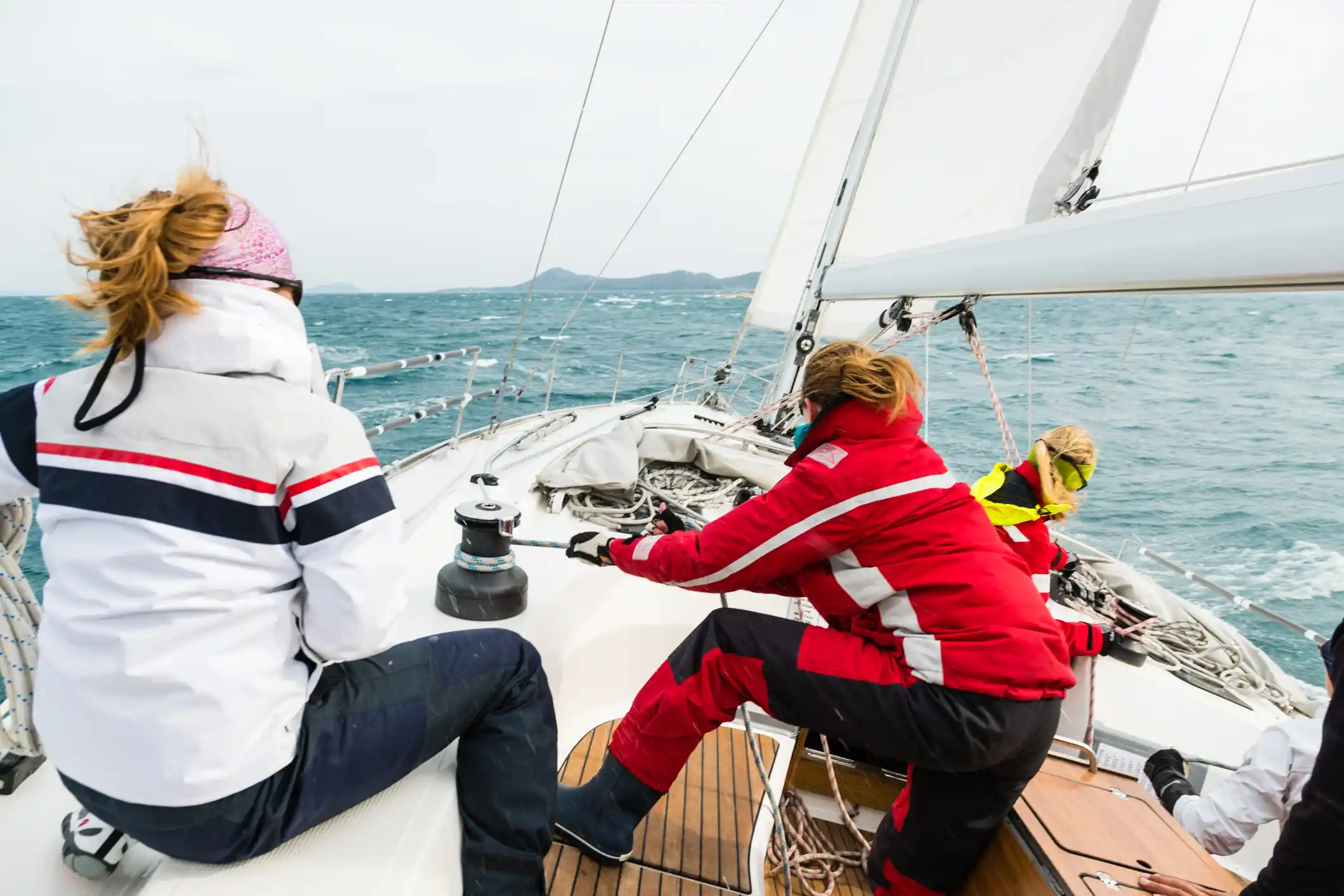
Most beginners reach basic sailing competency — enough to confidently handle a small boat in moderate conditions — within a structured course spanning a few weekends, typically 20–30 hours of instruction. Reaching a comfortable, independent skill level for coastal cruising generally takes a full season or two of regular practice beyond that initial course.
If you’re considering sailing lessons but unsure whether it fits your schedule, here’s a realistic breakdown of the actual time commitment.
Key Takeaways
- Basic competency (ASA 101-level skills): roughly 20–30 hours, often across a few weekends.
- Comfortable, independent sailing: typically a full season or two of regular practice beyond the initial course.
- Bareboat chartering readiness (ASA 101-103-104 track): several structured courses over months, not weeks.
- Prior boating experience shortens the curve, but isn’t required to start.
What’s a realistic timeline for a total beginner?
Most total beginners can reach basic sailing competency — understanding points of sail, tacking, docking, and basic safety — within a structured course spanning a long weekend or a few sessions, roughly 20–30 hours of combined instruction and practice. This is the level covered by an ASA 101-equivalent course.
Timeline at a Glance
| Skill level | Typical time investment |
| Basic competency (small boat, moderate conditions) | 20–30 hours, a few weekends |
| Comfortable, independent sailing | A full season or two of regular practice |
| Coastal cruising / bareboat chartering readiness | Multiple structured courses over several months |
| Confident in varied conditions | Ongoing — most sailors keep building skill for years |
Does age or fitness level matter?
Not significantly for basic competency — sailing is far more about technique and situational awareness than physical strength, which is part of why it’s approachable for a wide range of ages and fitness levels. Our ASA certified sailing school guide covers the specific course structure and prerequisites.
Do you need to own a boat to start learning?
No — most people start with a certified sailing school using instructional boats, and only consider buying once they’ve confirmed they enjoy it and have a feel for what size/type of boat fits them. If you’re at that stage, our family boat size guide is a useful next step.
What’s the fastest path if I want to charter a boat on vacation?
The ASA 101-103 track (or equivalent combo course) is specifically designed to get you to bareboat-charter-ready competency in a condensed timeframe — our ASA 101/103 combo course is built exactly for that goal.
Bottom line
Basic sailing competency is achievable in a few weekends; true independence takes a season or two of practice beyond that — either way, it’s far more approachable than most beginners expect. Learn more about our sailing school programs or contact us with questions.
FAQ
A question we often hear from prospective students: “I have almost no free time — is it realistic for me to learn to sail?” Yes — basic competency is achievable in roughly 20-30 hours of instruction, often condensed into a few weekends, which is a smaller time commitment than most people expect.
How many hours does it take to learn basic sailing? Roughly 20-30 hours of combined instruction and practice, typically structured across a few weekends.
How long until I can sail confidently on my own? Most sailors reach comfortable, independent skill after a full season or two of regular practice beyond their initial course.
Do I need to be in good physical shape to learn to sail? Not significantly — sailing relies far more on technique and situational awareness than physical strength, making it approachable for a wide range of fitness levels.
Do I need to own a boat before I start learning to sail? No — most people start at a certified sailing school using instructional boats and only consider buying once they know they enjoy it.